Welcome to Bouncia - Your Expert in Inflatable Water Parks and Diverse Sports Equipment

Bienvenue chez Bouncia - Votre expert en parcs aquatiques gonflables et en équipements sportifs divers.

Bienvenido a Bouncia - Tu Experto en Parques Acuáticos Hinchables y Equipamiento Deportivo Diverso

What Happens If the Inflatable Water Park You Buy Is Low Quality?

When a commercial water park project is delayed by a product problem, the damage is rarely limited to the inflatable itself. A small air leak can require inspection and repair. A failed connection can force an operator to close one section or the whole park. Missing or unsuitable certification documents can also delay approval, insurance review, or opening preparations.
For a buyer comparing an inflatable water park to buy, the lowest quotation may look attractive. However, the real decision is whether the system can remain safe, serviceable, and operational throughout the season. The Risks of Buying a Low-Quality Inflatable Water Park include repair costs, lost operating days, safety concerns, compliance problems, and damage to the operator’s reputation.
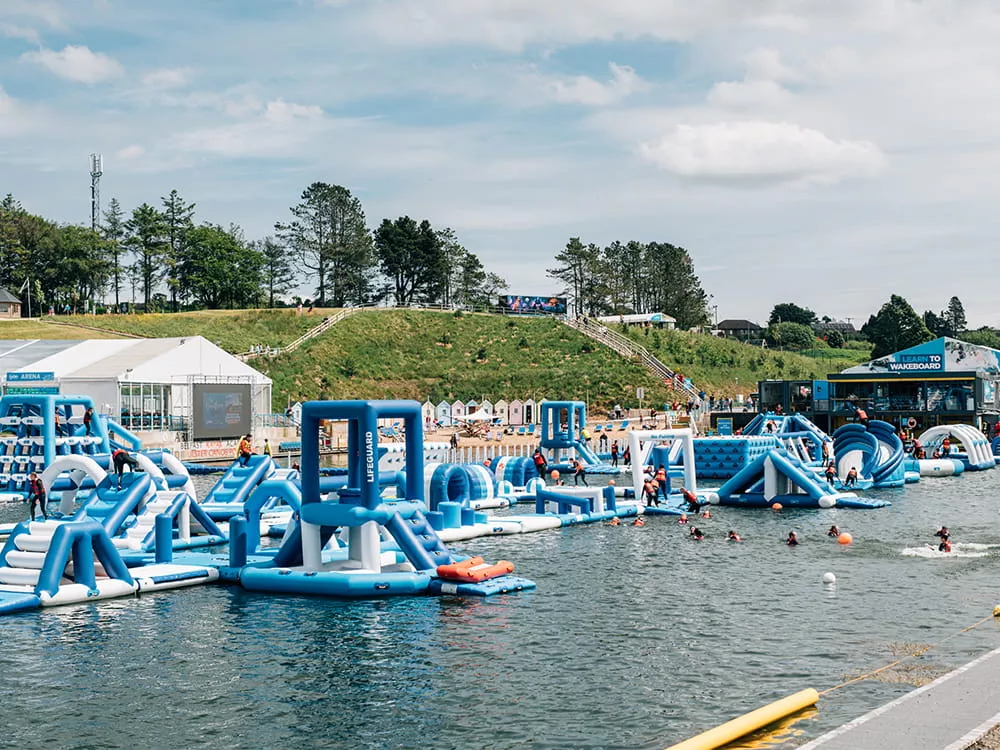
operating-inflatable-water-park-with-visitors-and-staff
An inflatable water park operating with visitors across multiple attractions
This article explains what low quality can look like, how product defects become business losses, and what evidence buyers should check before signing a contract or approving shipment.

Quick Answer

A low-quality inflatable water park can develop repeated air leaks, seam failures, damaged connection points, premature material wear, and certification or support problems. These defects may lead to temporary closure, emergency repairs, lost peak-season revenue, guest-safety concerns, and delayed regulatory or insurance approval. Before buying, verify written material specifications, weld and connection details, product-specific certification, factory QC records, acceptance criteria, warranty coverage, and after-sales response obligations.

What Does “Low Quality” Look Like in a Commercial Inflatable Water Park?

Low quality should not be judged only by color, shape, or how a new product looks in a photograph. Buyers need to examine whether the product matches its written specification and whether important load-bearing areas are designed, manufactured, and tested consistently. The following warning signs deserve closer review.

Air Leakage and Weak Welded Seams

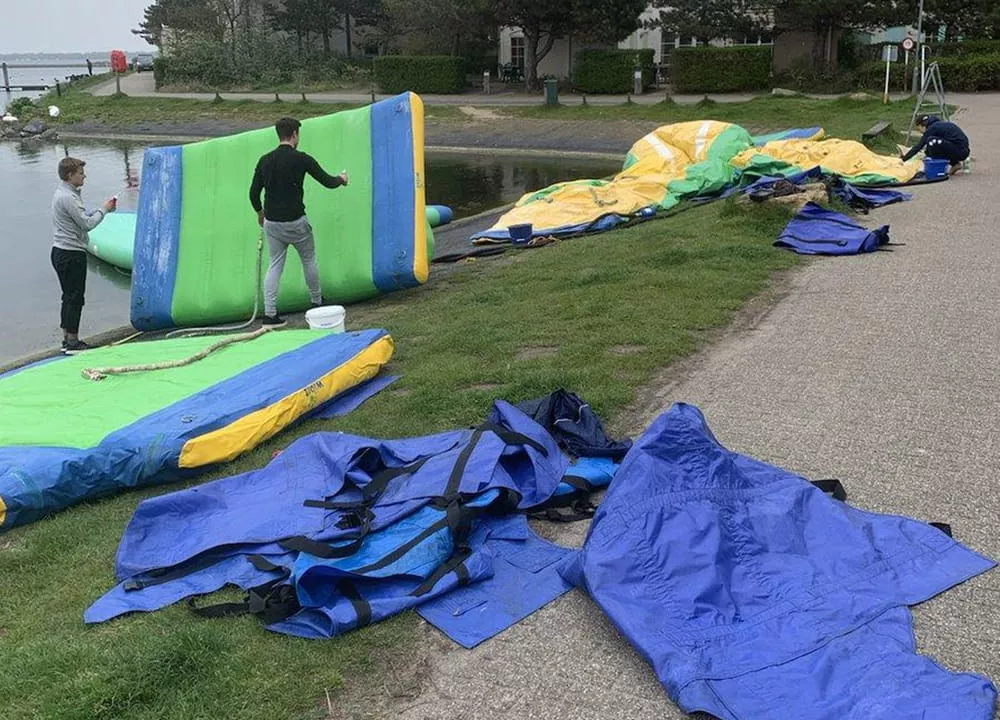
An airtight inflatable system will still require routine pressure checks, but it should not need repeated inflation because of unexplained air loss. Frequent pressure reduction may indicate valve problems, punctures, incomplete welding, or a seam beginning to open.
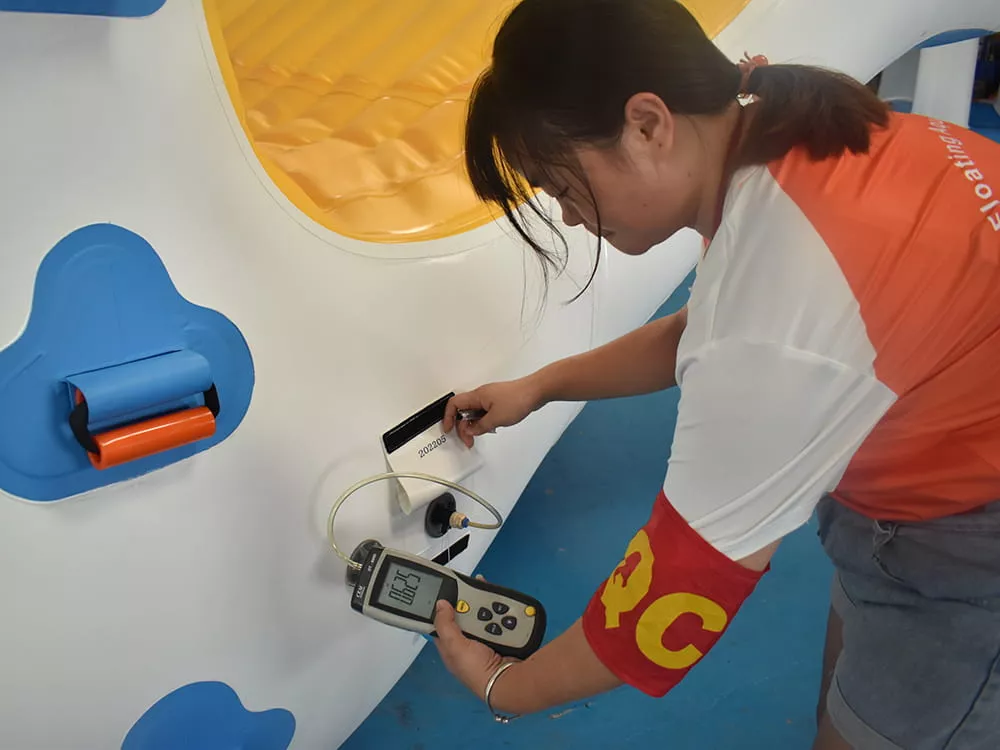
inflatable-water-park-pressure-check-at-air-valve
Staff checks inflatable water park pressure to detect air loss
Weak seams can become more serious when users repeatedly climb, jump, or land near the same area. Before shipment, ask for airtightness test evidence and close-up images of welded seams. A product that requires patches soon after installation can create repeated maintenance work and uncertainty for the operator.

Weak or Poorly Reinforced Connection Areas

Connection areas transfer movement and load between modules. If attachment points are poorly positioned, insufficiently reinforced, or incompatible with the connecting parts, the surrounding material may stretch or become damaged. Modules may also sit unevenly, creating gaps or alignment problems.
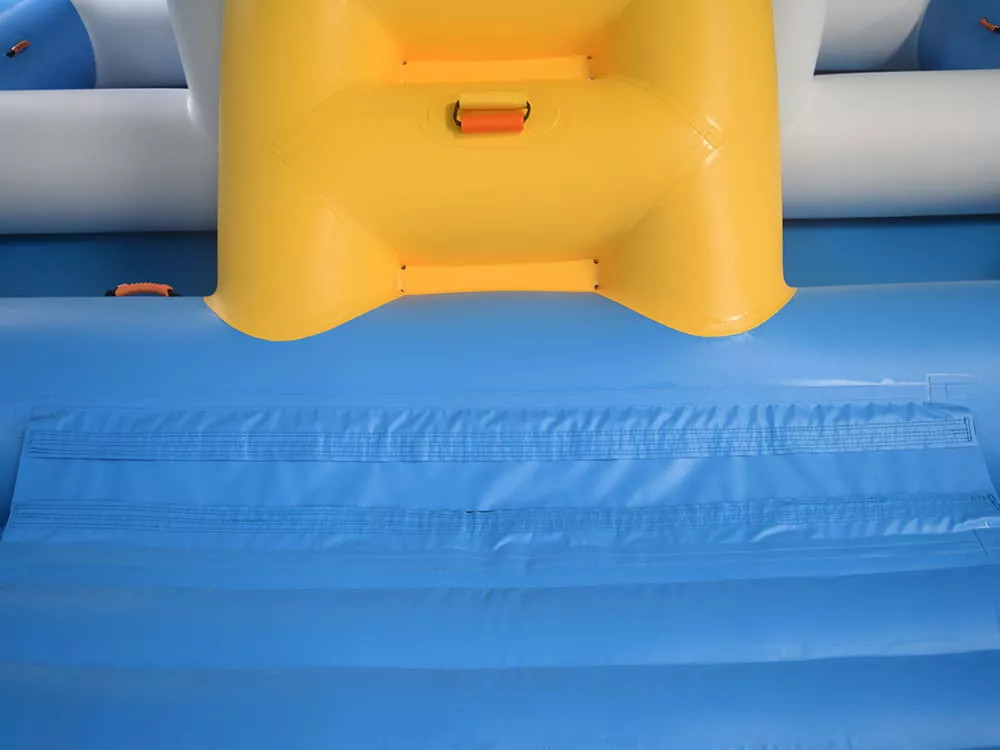
reinforced-inflatable-water-park-module-connection-detail
Reinforced inflatable water park connection supports load between modules
Buyers should review the connection design on the approved drawing and ask how high-load areas are reinforced. Detailed photographs or video should show both the connection hardware and the material around each attachment point, not only the completed park from a distance.

Material That Degrades Prematurely

Commercial water park equipment is exposed to sunlight, heat, water, repeated folding, cleaning, abrasion, and visitor traffic. Material that is unsuitable for the intended conditions may become brittle, lose coating, fade excessively, or wear through earlier than expected.
Material thickness can be relevant, but it is not the only quality indicator. Buyers should also confirm the material type, reinforcement structure, coating, intended UV and temperature performance, and traceability to the supplier’s stated test records. Written material specifications are more useful than a loose sample without a batch or product reference.
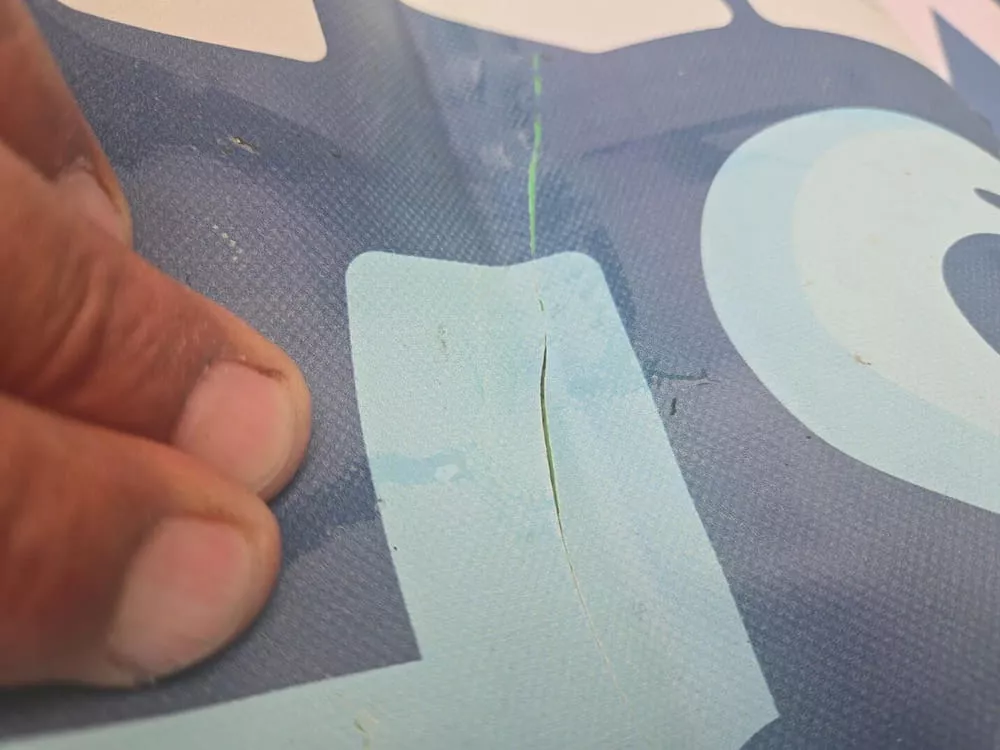
faded-and-cracked-inflatable-water-park-material
Faded inflatable water park material shows premature surface cracking

Incomplete or Inapplicable Certification Documents

A certificate can be genuine but still fail to cover the exact supplier, product, model, or standard needed for the project. A logo on a website or quotation is not enough. Buyers should compare the name on the document, covered product scope, referenced standard, issue or validity information, and issuing organization.
Requirements differ by market and project type, so buyers should confirm local rules with the relevant authority, insurer, consultant, or operator. Our guide to key safety standards provides additional points to review when evaluating documents. The essential step is to verify the certificate’s exact scope, not simply its existence.

Limited Spare Parts, Warranty or Technical Support

Even a repairable defect can cause long downtime when the supplier does not answer, cannot identify the correct repair method, or has no compatible spare part available. A vague warranty may also exclude freight, labor, on-site service, or damage that the buyer expected to be covered.
Before purchase, clarify who receives technical reports, how quickly the supplier must respond, which spare items are available, and whether repair instructions will be provided in a language the operating team can use. Support capability affects reopening time as much as the physical repair itself.

How Product Defects Turn Into Business Losses

The business effect of poor quality develops through a chain: a defect is discovered, the affected area is isolated, the park is inspected, a repair decision is made, and the equipment must be retested before reopening. Understanding this chain helps buyers assess quality as an operating issue, not only a manufacturing issue.

Temporary Closure and Lost Peak-Season Revenue

If a defect affects pressure, structural integrity, or a critical connection, the operator may need to stop using the relevant module immediately. Depending on the park layout, one unavailable module may interrupt the visitor route or require closure of a larger section.
A practical estimate of downtime exposure is: affected operating days × expected daily revenue, plus any refunds, rescheduling costs, or lost secondary sales. This is not a universal loss figure; each operator should use its own ticket price, expected attendance, operating hours, and seasonal demand. During a short peak season, even a few closed days can be commercially significant.
closed-inflatable-water-park-undergoing-maintenance
Temporary inflatable water park closure can reduce peak-season revenue

Repair, Freight and Replacement Costs

The repair material itself may be inexpensive, but the full cost can include staff time, technician travel, emergency freight, lifting or access equipment, drying and curing time, retesting, and replacement of a complete module. International shipping can extend the delay if the correct component is not locally available.
Buyers should therefore compare not only the product price but also the supplier’s repair process, spare-parts plan, and responsibility for defect-related shipping. Small defects can create large logistics costs when support arrangements are unclear.

Guest Safety, Insurance and Regulatory Exposure

Loss of air pressure can change the shape or stability of an inflatable. Damage around a connection point can affect how modules remain aligned under movement and visitor load. These conditions may create a safety concern even before a complete failure occurs.
After an incident or serious defect, an insurer, local authority, or project consultant may request inspection records, operating procedures, maintenance logs, or product documents. Missing or unsuitable records can delay the review. For this reason, operators should maintain clear product and inspection records and confirm all local obligations before opening.

Reviews, Refunds and Brand Reputation

Guests usually do not distinguish between a manufacturing problem and an operating problem. They see an attraction that is closed, a booking that is cancelled, or an experience that does not match expectations. This can lead to refund requests, negative reviews, complaints, and lower repeat visits.
For a commercial inflatable water park, operating continuity directly affects customer confidence. Reputation loss can continue after the physical product has been repaired, especially if the operator communicates poorly or experiences repeated closures.

How to Identify Quality Risks Before You Buy

A reliable purchasing review should be based on evidence that can be compared across suppliers. General statements such as “best material”, “international standard”,”or “long warranty” are not enough without written specifications, product-specific records, and clear responsibilities.

Verify the Written Material Specification

Ask the supplier to state the material specification in the quotation, technical agreement, or contract appendix. Depending on the product, this may include material construction, thickness, coating, reinforcement, and claims related to UV or temperature resistance.
Confirm that the supplied product will match the approved specification and ask how the material can be traced to a batch, purchase record, or inspection report. Do not rely on appearance alone. A visually similar sample may not prove what will be used in final production.

Review Welds, Reinforcements and Connection Design

Request clear images or video of welds, corners, handles, anchor points, and module connections during production or final inspection. Compare these details with the approved drawing. High-load and repeated-contact areas should receive particular attention.
The review should also consider whether staff can inspect the connection after installation and whether the selected parts are compatible across the park. Connection details need documented approval before production, because they can be difficult and expensive to change after delivery.

Check Certification Scope, Not Just the Certificate Logo

Read the document rather than accepting a screenshot of a logo. Check the supplier or manufacturer name, product category or model, applicable standard, report or certificate number, date, and issuing body. If a test report is provided, confirm what sample was tested and whether it represents the product being purchased.
Certification does not replace site approval, operating procedures, or local risk assessment. Buyers should independently confirm the requirements for their country and venue. Product-specific coverage matters more than a general marketing claim.

Ask for Factory QC and Finished-Product Test Records

factory-qc-inspection-of-inflatable-water-park
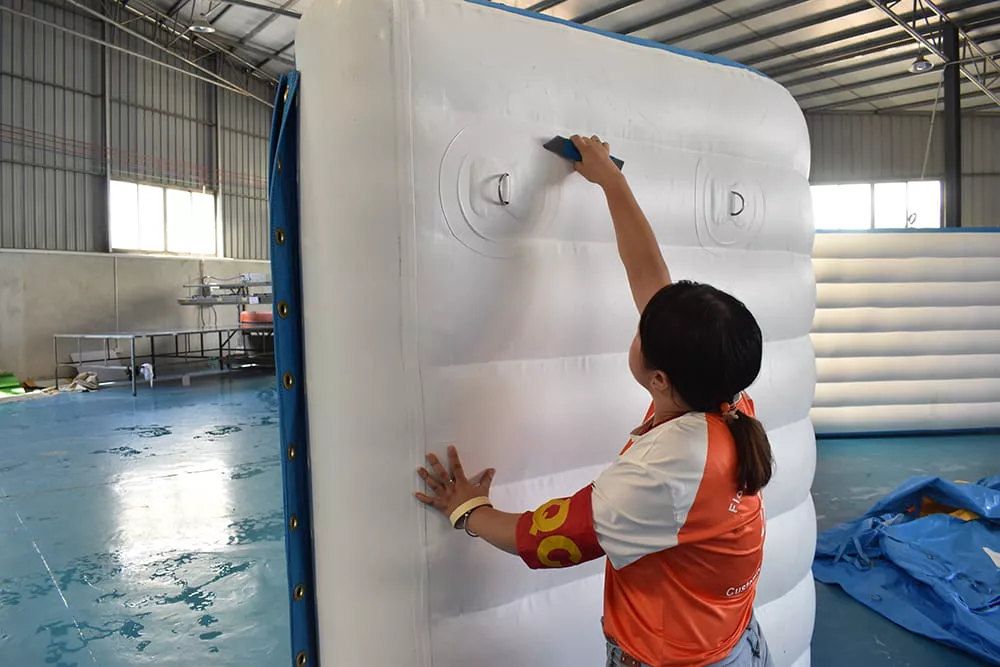
Staff performs inflatable water park QC before final delivery
A quality-control process should show what is checked, when it is checked, who records the result, and what happens when a problem is found. Useful evidence may include incoming-material inspection, in-process checks, airtightness or pressure tests, final visual inspection, dimensional checks, and packing records.
Buyers can also ask how serial numbers or production batches are tracked and how nonconforming products are repaired and retested. QC records should match the order, not only show a generic factory checklist from another project.

Evaluate After-Sales Response Capability

Ask who will manage a technical claim after delivery and what information the buyer must provide. A practical process may require photographs, video, pressure observations, product identification, installation conditions, and a description of when the problem began.
Confirm the expected response time, remote diagnosis method, availability of repair materials and parts, and escalation route for serious defects. A named support process is more useful than a general promise of “lifetime service”.

Put Quality and Remedies Into the Purchase Contract

Quality requirements become much easier to enforce when they are attached to the contract as measurable specifications and acceptance criteria. Verbal explanations and chat messages may not clearly define what was included, who is responsible, or how a defect will be resolved.
The contract or its technical appendices should address:
  • Approved drawings and specifications, including materials, dimensions, connection details, included accessories, and documentation;
  • The pre-shipment evidence the supplier must provide, such as inspection images, test records, and packing information;
  • The acceptance process, inspection period, and method for reporting visible and hidden defects;
  • How defects are classified and when repair, replacement, credit, or another remedy applies;
  • Warranty duration, exclusions, maintenance obligations, and evidence required for a claim;
  • Response times, spare-parts support, repair guidance, and technical escalation;
  • Responsibility for defect-related freight, labor, travel, or replacement costs; and
  • The deadline for providing certificates, manuals, drawings, and other agreed documents.
Contract terms should reflect the project location, payment arrangement, and applicable law. Buyers should obtain appropriate local legal or commercial advice instead of assuming one standard clause will work in every country. The objective is to make quality promises measurable and to agree on remedies before a problem occurs.

A Pre-Purchase Risk Check Buyers Can Use

The following table can help a procurement team compare supplier claims with the evidence needed for a purchasing decision. A red flag does not automatically prove that a product is poor quality, but it should trigger further questions before approval.
Risk Area
Red Flag
Evidence to Request
Possible Operating Consequence
Materials
Only general claims; no written specification or traceability
Material specification, applicable test evidence, batch or supplier records
Premature wear, coating damage, shorter service life
Welded seams
Uneven seams, repeated leaks, no finished-product test evidence
Close-up inspection images, airtightness or pressure-test records
Repair work, pressure loss, module closure
Connections
Unclear drawings, weak reinforcement, incompatible parts
Approved connection drawing, reinforcement details, installation evidence
Misalignment, local damage, route interruption
Certification
Logo only; document scope does not match the order
Full certificate/report, scope, model, standard, date, issuer verification
Approval, insurance, or compliance delays
Factory QC
Generic checklist with no order or batch reference
Incoming, in-process, final-test, and nonconformance records
Undetected defects and inconsistent delivery
Warranty and support
Vague coverage, no response time, no spare-parts plan
Written warranty, claim process, contacts, response and remedy terms
Longer downtime and disputed costs
Quotation scope
Price is much lower but inclusions are unclear
Itemized comparison of specifications, testing, accessories, documents, freight, and support
Unexpected costs or missing project-critical items
When a quotation is unusually low, compare what may be missing before deciding why. Lower price alone does not prove poor quality. However, omitted testing, reduced specifications, incomplete accessories, limited documentation, or unclear support can transfer risk to the buyer. Use evidence before price assumptions. After completing these checks, buyers can compare an inflatable water park to buy with a clearer understanding of what is included and how the supplier will support the project.

Conclusion

The real cost of a low-quality inflatable water park is not limited to the purchase price or one repair. Air leaks, weak seams, damaged connections, early material wear, unsuitable documents, and poor after-sales support can lead to closure, emergency costs, lost revenue, safety concerns, and reputational damage.
Before selecting a system, compare verifiable product evidence: written specifications, weld and connection details, product-specific certification, QC records, inspection criteria, warranty remedies, spare-parts availability, and response times. Put the agreed requirements into the contract and confirm local compliance obligations independently.
A strong purchasing decision protects operating continuity throughout the season. Buyers planning a new project can review suitable commercial park options and discuss site conditions, capacity, design, documentation, and support requirements before approving production.

FAQs

What are the most common signs of a low-quality inflatable water park?

Repeated air loss, uneven or opening seams, weakly reinforced connection areas, early coating or material damage, incomplete product documentation, and unclear warranty support are common warning signs. Buyers should confirm them with specifications and test records rather than appearance alone.

How can I verify an inflatable water park’s quality before shipment?

Approve the final drawings and specifications, request material and QC records, review detailed weld and connection evidence, verify the scope of certification, and define a documented pre-shipment inspection and acceptance process.

What should a purchase contract include if quality problems occur?

It should identify the approved product specifications, acceptance criteria, defect-reporting process, repair or replacement responsibility, response times, warranty limits, spare-parts support, and responsibility for related freight or service costs. These points make the agreed remedies and responsibilities clearer.

GET IN TOUCH WITH US

If you want to learn more about us or our products, welcome to leave a message below.

error: Content is protected !!