Welcome to Bouncia - Your Expert in Inflatable Water Parks and Diverse Sports Equipment

Bienvenue chez Bouncia - Votre expert en parcs aquatiques gonflables et en équipements sportifs divers.

Bienvenido a Bouncia - Tu Experto en Parques Acuáticos Hinchables y Equipamiento Deportivo Diverso

Inflatable Water Park for Lake: Water Depth, Bottom Conditions and Anchoring Explained

For many investors planning an Inflatable Water Park for Lake project, the main concern is not choosing products, but whether the lake is suitable for installation. Even with a large water area, insufficient water depth, unsuitable lake bottom conditions, or strong wind and waves can still create safety and maintenance risks.
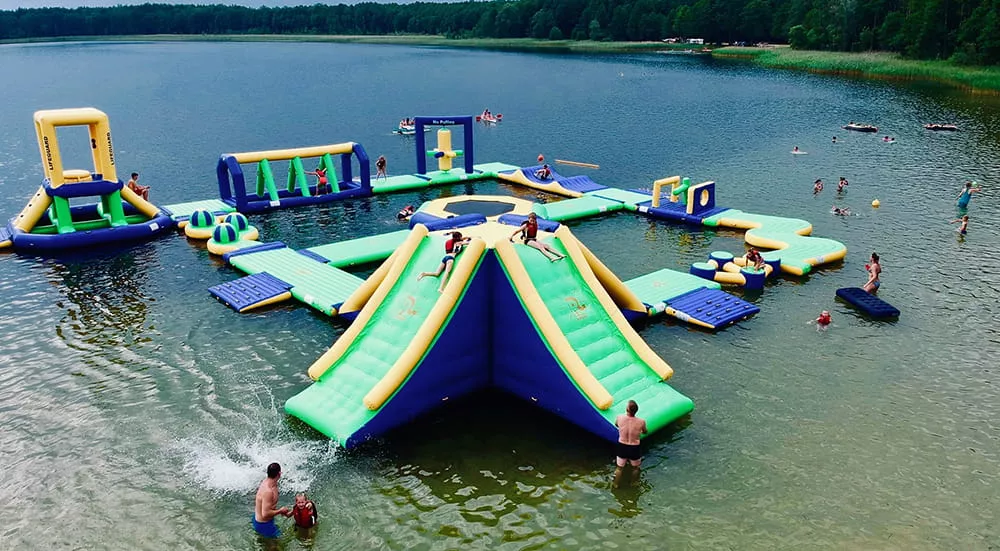
inflatable-water-park-installed-on-lake
Inflatable water park project installed on a lake
Therefore, understanding water depth requirements, bottom conditions, and anchoring systems before planning is essential to avoid installation problems and reduce long-term costs.

Quick Answer: What Type of Lake Is Suitable?

Most commercial Inflatable Water Park for Lake projects are suitable in:
  • Lakes with water depth over 2m
  • Stable mud, sand, or mixed lake bottom
  • Low to medium wind and wave conditions
  • Stable seasonal water level
  • Enough open water space for installation and operation
Key factors to evaluate:
  • Water depth
  • Lake bottom type
  • Wind and wave conditions
  • Water level changes
  • Anchoring conditions
  • Available operational area
These factors together decide if the project is suitable for long-term operation.

Why Not All Lakes Are Suitable?

Many investors think any lake can host an Inflatable Water Park for Lake, but this is not true. A successful project must meet several conditions:
Evaluation Factor
Importance
Water depth
Very High
Lake bottom condition
Very High
Wind & waves
High
Water level change
High
Operational space
High
Local approval
High

How Deep Should a Lake Be?

Water depth is not based on visitor capacity. It depends on product height. A unified formula is used to calculate minimum safe water depth.

Water Depth Formula

Minimum water depth = (Product height + average human height) ÷ 2
Where:
  • Average human height = 1.8m (5.9ft)
  • Product height = highest structure height of equipment

Example

If a slide tower is 3m high:
(1.8 + 3) ÷ 2 = 2.4m
So the minimum required water depth is 2.4m.

Water Depth Reference by Facility Type

(1) Standard Obstacle Courses

Examples: basic tracks, small floating modules
  • Product height: around 1m
  • Recommended depth: around 1.4m 
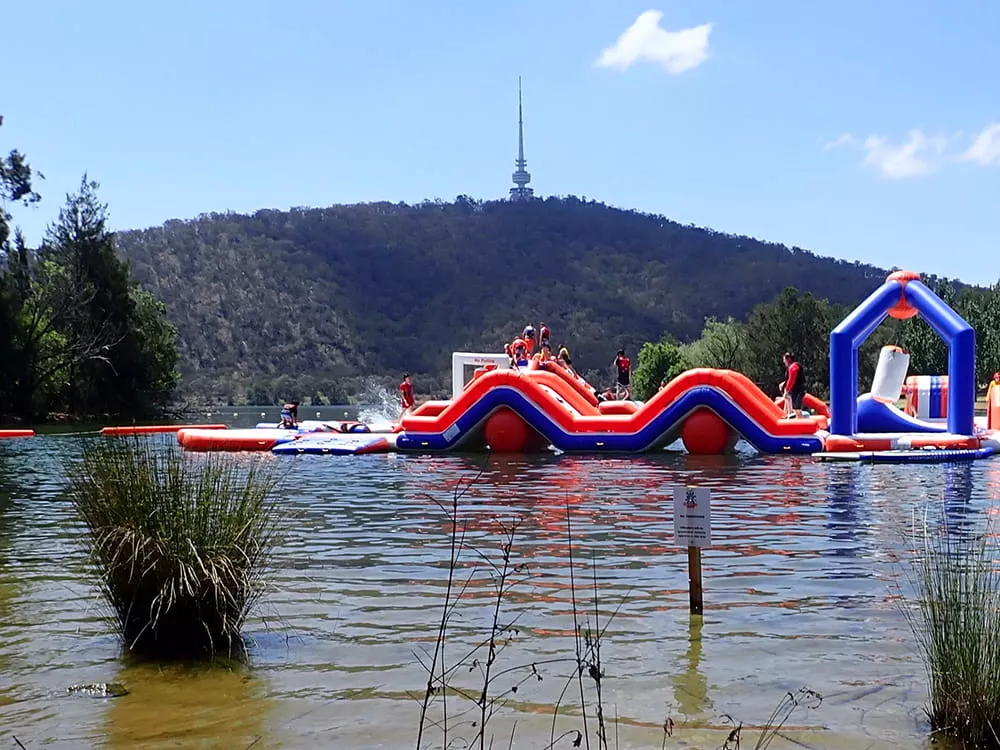
inflatable-water-park-standard-equipment
Standard inflatable water park equipment on lake

(2) Climbing & Medium Structures

Examples: climbing walls, challenge routes
  • Product height: around 3m
  • Recommended depth: around 2.4m 
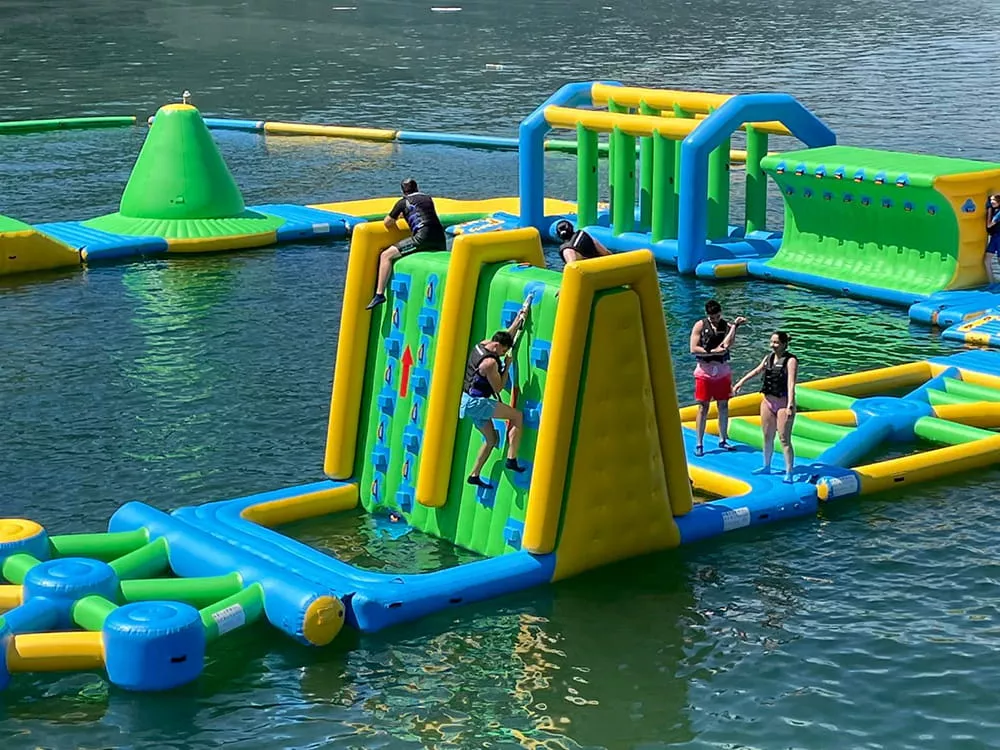
inflatable-water-park-climbing-structure
Climbing structure in inflatable water park

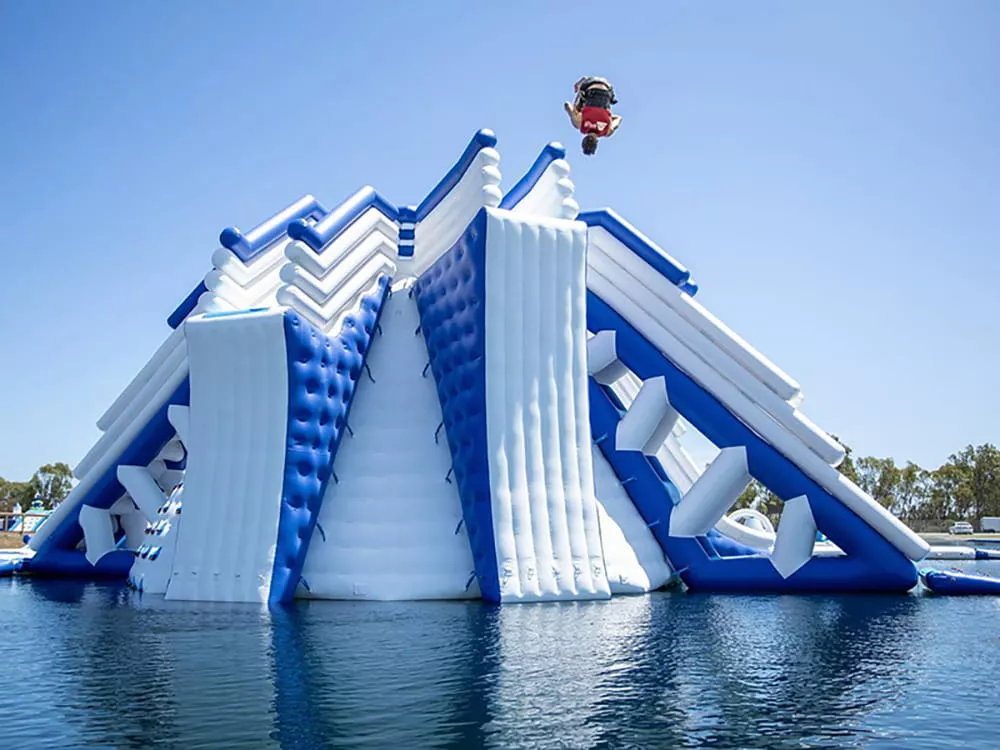
(3) Large Slides & Tower Systems

Examples: Big Slide, combined towers
  • Product height: around 5m
  • Recommended depth: around 3.4m 
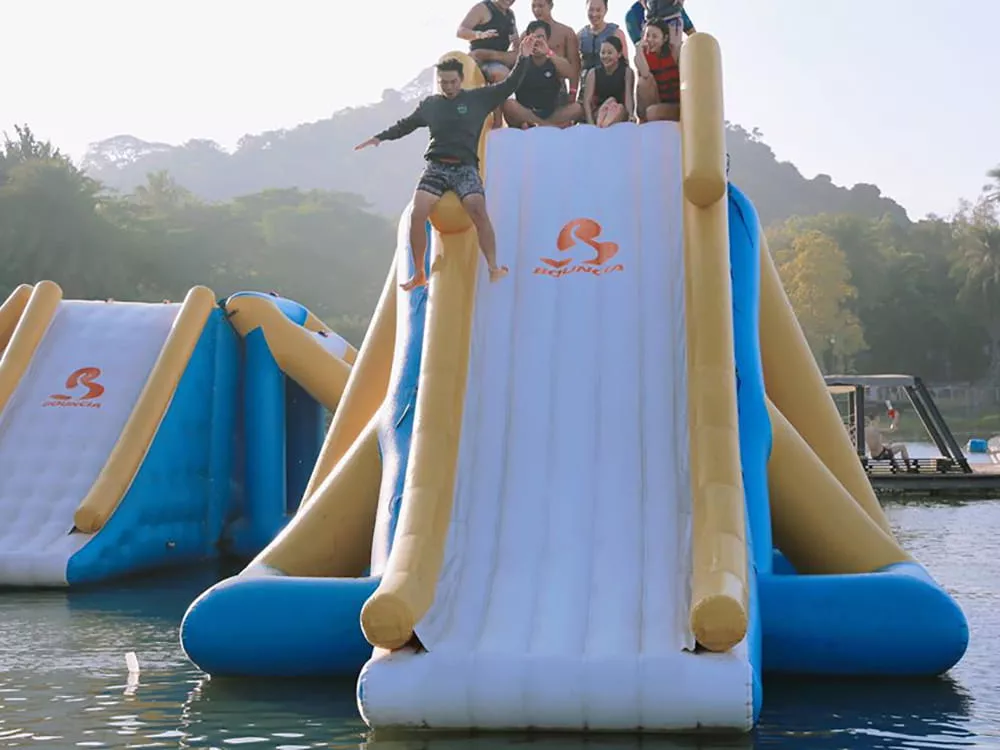
inflatable-water-park-large-slide-on-lake
Large inflatable water park slide on lake

(4) Ultra-Large Structures

Examples: jumping systems
  • Product height: around 6m
  • Recommended depth: around 3.9m
inflatable-water-park-jumping-system
A giant jumping system in inflatable water park

How Lake Bottom Conditions Affect Installation

In addition to water depth, lake bottom conditions also play a key role in selecting anchoring systems, installation difficulty, and long-term stability of the project. Understanding the bottom conditions during the planning stage helps choose the most suitable installation method.

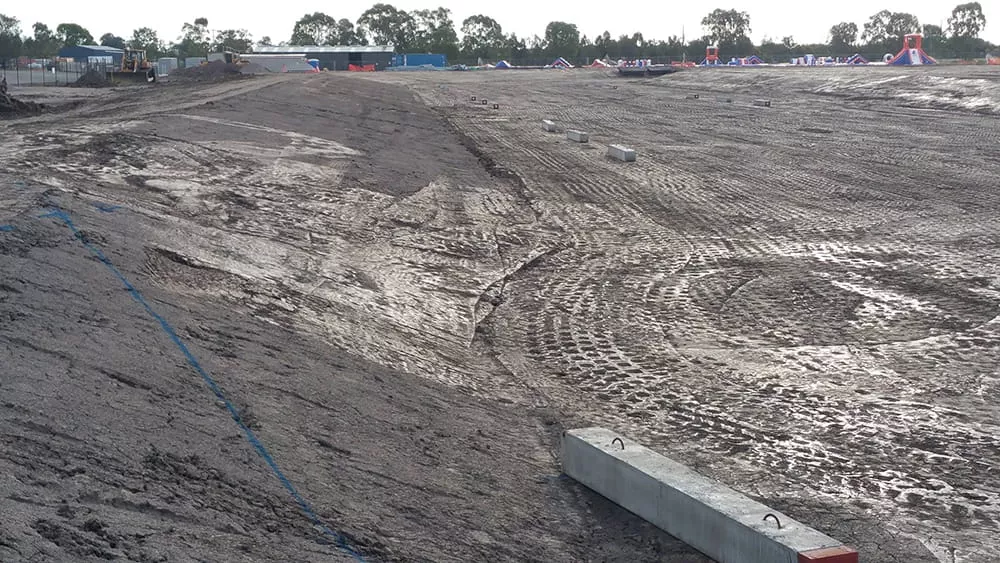
(1) Mud Bottom

This is one of the most common lake bottom conditions.
Advantages:
  • Relatively easy to install
  • Suitable for most anchoring systems
inflatable-water-park-mud-bottom
Mud bottom preparation for inflatable water park installation
  • Lower construction cost in most cases
Important Notes:
  • It is necessary to check mud thickness and bearing capacity
  • Excessively soft mud layers may cause anchors or concrete blocks to sink
  • Some projects may require heavier anchors or more anchoring points

(2) Sand Bottom

Sand bottom is generally considered an ideal installation condition.
Advantages:
  • Good anchoring stability
  • High installation efficiency
  • Compatible with multiple anchoring systems
Suitable anchoring methods:
  • Concrete block anchoring
  • Helical Anchor (Screw Anchor)
Important Notes:
  • In areas with strong wind and waves, anchoring design should be adjusted based on real site conditions

(3) Gravel Bottom

Gravel bottom is considered a medium-difficulty installation environment.
Advantages:
  • Relatively stable lakebed
  • Low risk of obvious sedimentation
  • Concrete block anchoring usually performs well
Important Notes:
  • Large gravel or stones may increase installation difficulty
  • Installation efficiency of some helical anchors may be affected
  • It is recommended to check the thickness and distribution of the gravel layer before installation

(4) Rocky Bottom

Rocky bottom is a condition that requires special evaluation.
Advantages:
  • Very strong and stable lakebed
  • Almost no sedimentation risk
Important Notes:
  • Standard helical anchors may not be directly installable
  • Some projects may require customized anchoring solutions
  • In special cases, drilling anchors or special connection systems may be required
  • Construction cost and installation difficulty are generally higher than other lake bottom types

Recommendation

Before project planning, a professional site survey is strongly recommended, including:
  • Water depth measurement
  • Lake bottom type identification
  • Mud layer thickness check
  • Wind and wave condition analysis
These factors help select the most suitable anchoring system and significantly improve long-term safety and operational stability of an Inflatable Water Park for Lake project.

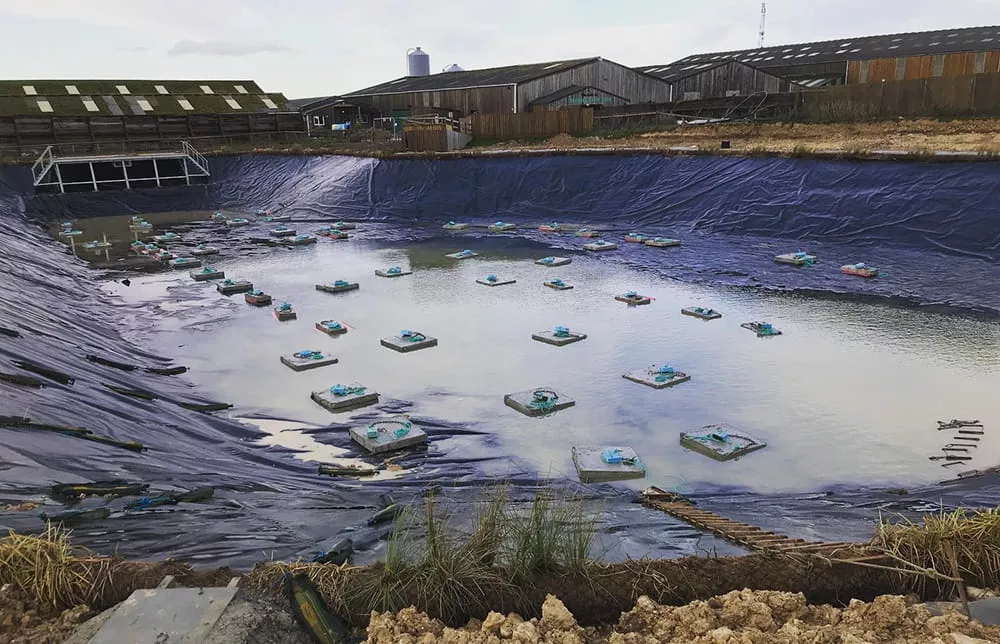
Common Anchoring Systems

1. Concrete Block Anchoring

  • Most widely used system
  • Suitable for mud, sand, gravel, and partial rocky bottom
  • High stability
  • Requires lifting equipment
inflatable-water-park-concrete-block-anchoring-system-installation
Concrete block anchoring system for inflatable water park installation

2. Helical Anchor (Screw Anchor)

  • Installed by rotating into ground
  • Suitable for sand and soft mud
  • Lightweight and efficient
  • Not suitable for rock bottom

Wind and Wave Conditions Matter More Than Expected

A proper anchoring system is essential for the safe operation of an Inflatable Water Park for Lake. In real projects, the anchoring solution must be selected based on water depth, lake bottom conditions, wind and wave conditions, and local regulations.

1. Concrete Block Anchoring

This is one of the most widely used anchoring systems for commercial inflatable water parks worldwide. It uses multiple heavy concrete blocks combined with chains to create a stable anchoring structure.
Suitable for:
  • Mud Bottom
  • Sand Bottom
  • Gravel Bottom
  • Partial Rocky Bottom
Advantages:
  • High versatility
  • Strong stability
  • Suitable for medium and large-scale projects
  • Less sensitive to lake bottom conditions
Important Notes:
  • Higher transportation and installation cost
  • Usually requires lifting equipment or working boats

2. Helical Anchor (Screw Anchor)

Helical anchors are installed by rotating into the lakebed soil to provide holding power. In some regions, they are also called screw anchors.
Suitable for:
  • Sand Bottom (Sand Bottom)
  • Soft Mud Bottom (Mud Bottom)
  • Mixed soil conditions
Advantages:
  • Small anchor size and easy transportation
  • Strong pull-out resistance
  • Good option for projects with higher environmental requirements (less invasive installation)
Important Notes:
  • High requirement for lake bottom conditions
  • Not suitable for solid rocky bottoms
  • Requires professional installation equipment and experience

Comparison of Anchoring Methods

Anchoring Method
Mud Bottom
Sand Bottom
Gravel Bottom
Rocky Bottom
Overall Cost
Concrete Block Anchoring
Excellent
Excellent
Excellent
Good
High
Helical Anchor
Good
Excellent
Fair
Not suitable
Medium
Important Notice
There is no single anchoring system that fits all lake conditions.
The final selection must be based on:
  • Water depth
  • Lake bottom conditions
  • Project scale
  • Local approval and regulations
For large-scale commercial Inflatable Water Park for Lake projects, concrete block anchoring remains the most widely used and reliable solution worldwide.

Why Wind and Wave Conditions Matter More Than Most People Think

Many projects focus only on water depth during site selection, while ignoring wind and wave conditions.
In reality, wind and waves can directly affect:
  • Product stability
  • Lifespan of connection systems
  • Maintenance frequency
  • Visitor experience
For open lake environments, it is strongly recommended to evaluate:
  • Maximum wind speed
  • Prevailing wind direction throughout the year
  • Wave height conditions
  • Frequency of storm or extreme weather events
If a lake experiences strong and frequent wind and waves, the stability of the connection system can become more important than anchoring strength itself in ensuring safe long-term operation of an Inflatable Water Park for Lake.

Does Water Level Change Affect Operation?

Yes, but for most seasonal commercial projects, the most important factor is water level during the operating season, not the level at the time of installation.
Many lakes experience water level fluctuations in summer due to rainfall, drought, reservoir management, or irrigation usage. If these factors are not considered during planning, the following issues may occur:
  • Some areas may become too shallow
  • Anchor lines may become too loose or overly tensioned
  • Equipment position may shift
  • Certain attractions may need to be closed
Therefore, during the planning stage, it is recommended to evaluate the maximum and minimum water levels during the operating season (usually summer) rather than relying only on the installation-day water depth.

Key Water Level Factors to Monitor During Operation

Item
What to Check
Summer peak water level
Whether it affects shore connections
Summer lowest water level
Whether minimum safe depth is met
Monthly fluctuation range
Whether anchor lines need adjustment
Water level after heavy rain
Whether system stability is affected
For most lake projects, if seasonal water level changes remain within a controllable range, they usually do not significantly affect the operation of an Inflatable Water Park for Lake.

What Information Should Be Prepared Before Building a Project?

To help suppliers provide accurate design and quotation, it is recommended to prepare the following information in advance:
  • Lake length and width
  • Water depth data
  • Lake bottom conditions
  • Site photos
  • Google Maps location
  • Target capacity
  • Budget range
  • Wind and wave conditions
Providing this information allows suppliers to quickly evaluate project feasibility and create more accurate layout designs.
For investors searching for commercial inflatable water park for lake projects, preparing these details in advance also helps obtain more precise solutions, configurations, and investment estimates.

FAQ

(1) What is the minimum water depth?
It depends on product height. Use the formula: (Product height + average human height) ÷ 2.
(2) Can mud bottom lakes be used?
Yes, but anchoring must be properly designed.
(3) Can lakes with changing water levels be used?
Yes, if seasonal variation is within safe range.
(4) Which lakes are not suitable?
  • Very shallow water
  • Strong wind and waves
  • Heavy boat traffic
  • Extreme water level changes
  • Unstable lake bottom conditions
Choosing a suitable lake for an Inflatable Water Park for Lake project is not only about lake size. Water depth, bottom conditions, wind and waves, water level changes, and anchoring systems all directly affect safety, operation stability, and long-term ROI. Early professional site evaluation helps reduce installation risks and maintenance costs.
If you are planning a project, you can share your lake photos, location, water depth, and target capacity with Bouncia. We will provide a free initial layout and project suggestion to help you quickly assess feasibility and understand investment cost and product configuration for different project scales.

GET IN TOUCH WITH US

If you want to learn more about us or our products, welcome to leave a message below.