Welcome to Bouncia - Your Expert in Inflatable Water Parks and Diverse Sports Equipment

Bienvenue chez Bouncia - Votre expert en parcs aquatiques gonflables et en équipements sportifs divers.

Bienvenido a Bouncia - Tu Experto en Parques Acuáticos Hinchables y Equipamiento Deportivo Diverso

What Is the Minimum Investment to Start a Commercial Inflatable Water Park?

Starting a commercial inflatable water park is not only a matter of finding the lowest equipment price. The real question is whether your budget is sufficient to purchase, install and prepare a park that can open safely, serve the planned number of visitors and continue operating through normal startup challenges.
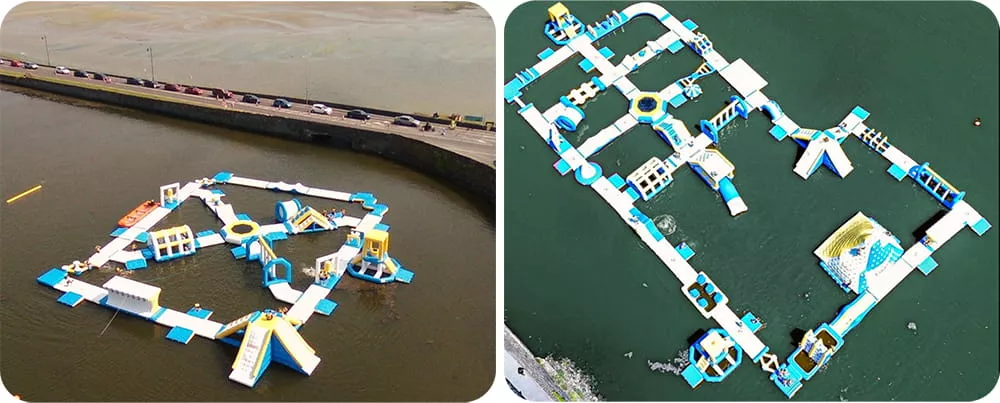
Commercial inflatable water park operating on a lake
A commercial inflatable water park operating beside a lakeshore
For a first-time investor, the minimum investment for a commercial inflatable water park should therefore be measured as a launch-ready budget, not simply as the price shown in an equipment quotation. This article focuses on that minimum viable threshold: the costs that should not be removed, the parts of the project that can start small, and the signs that a budget is too low for commercial operation.

Quick Answer: What Is the Minimum Investment?

A small commercial inflatable water park equipment package may start at around US$14,000, but this is not a universal all-in startup budget. There is no single minimum total investment that applies to every project, because the final amount depends on the site, planned capacity, location, shipping requirements and local rules.
A practical minimum must cover the commercial park system, site assessment and anchoring, freight and installation, safety and compliance preparation, pre-opening operating needs and a contingency reserve. If the available budget is limited, reduce the opening size or phase optional modules. Do not remove costs that are necessary for safe and reliable operation.
Minimum Investment Should Mean Launch-Ready, Not Equipment-Only

When buyers compare quotations, three different figures are often treated as if they were the same: the equipment price, the installed project cost and the total capital required to open. They are not the same.
  • Equipment price: the quoted price of the inflatable units and the included accessories.
  • Installed project cost: the equipment price plus project-specific expenses such as freight, local handling, anchoring and installation.
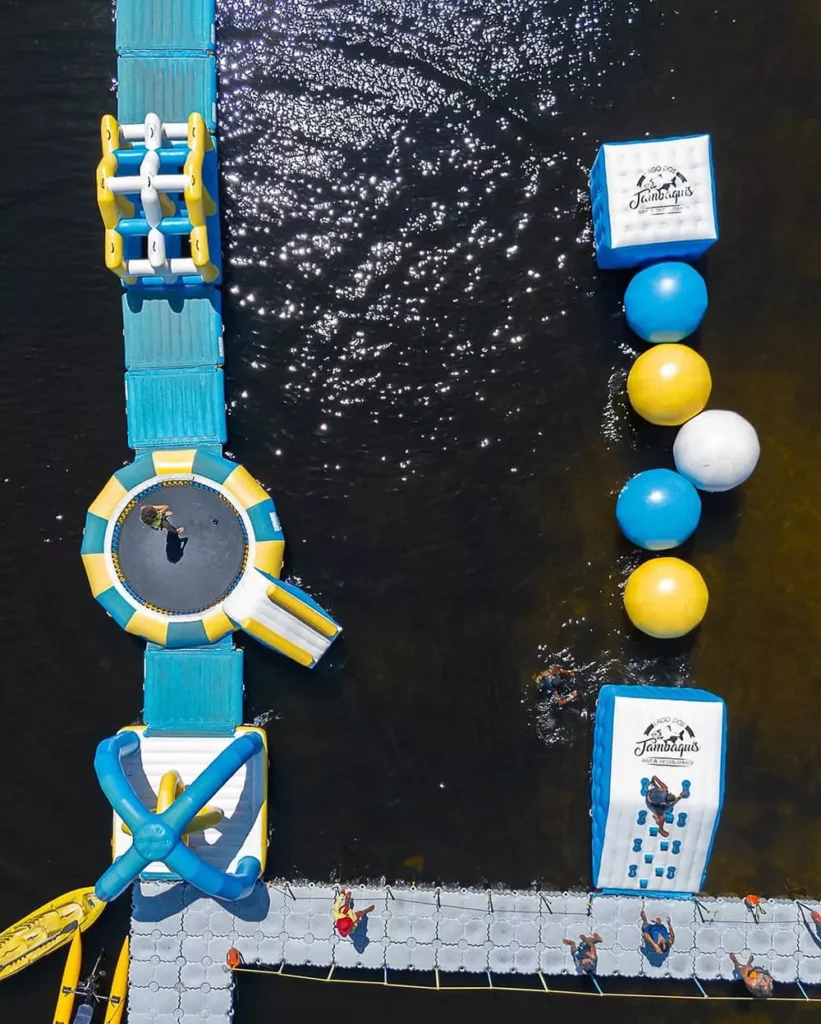
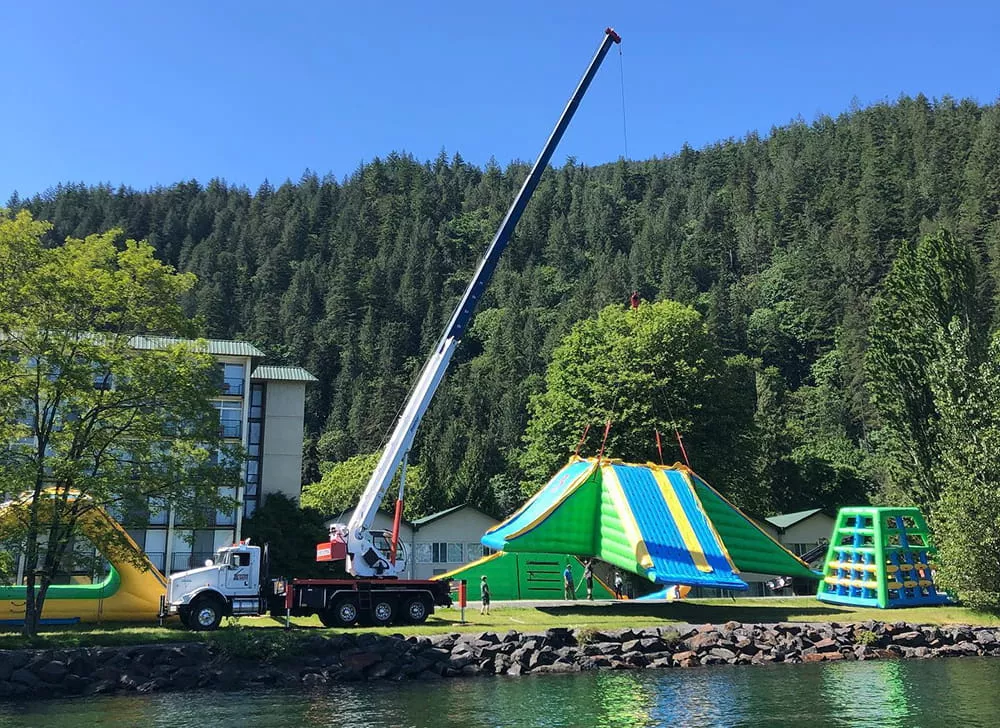
Installation as part of the total inflatable water park cost
Installation expenses also contribute to the total cost of an inflatable water park
  • Launch-ready capital: the amount needed to complete the installation, meet safety and regulatory requirements, prepare the operating team and retain enough cash for the opening period.
A minimum viable commercial park is not necessarily a large park. It is a park that fits its site, supports its stated capacity, can be supervised properly and has the required systems to open. An investor reviewing an inflatable water park for sale should therefore compare complete project scope, not only the number at the bottom of the product quotation.

The Investments You Should Not Cut

A limited budget requires priorities. The correct priority is to protect the parts that determine whether the park can operate safely and commercially. The following items form the non-negotiable spending floor.

A Commercial-Grade Park Sized for the Intended Capacity

The opening layout should match expected visitor volume and the way guests will move through the course. A park that is too small for the advertised capacity can create queues, congestion and supervision problems. A collection of inexpensive individual pieces may also fail to create a coherent route or an efficient entry and exit system.
Commercial suitability also depends on whether the park layout, access points and installation requirements match the intended operating environment. A lower-budget plan should reduce the initial scale or capacity rather than remove the essential elements required for safe and practical operation.

Site Assessment, Anchoring and Safe Installation

Before the layout is finalized, the project team should confirm water depth, available water area, shoreline access, lakebed or seabed conditions, typical wind exposure and the proposed entry and exit locations. These conditions affect both the layout and the anchoring plan.
Underwater concrete anchors positioned according to the inflatable water park site plan
Concrete anchors for the inflatable water park follow the site-specific anchoring plan
Anchoring should never be treated as an optional accessory. The method, number of anchor points and local installation work must suit the actual site. The same park can require different arrangements at two different locations. For a deeper explanation of how water conditions affect the project total, review these inflatable water park cost factors before approving the budget.

Safety, Compliance and Operating Readiness

A park cannot be considered ready to open simply because the inflatables have been installed. The operator may also need safety equipment, operating rules and signs, inspection procedures, trained staff or lifeguards, visitor-control procedures, permits and insurance. Exact requirements vary by country and site, so they should be confirmed with the relevant local authorities, insurer and professional advisers.
The important budgeting rule is simple: confirm these requirements early. Discovering them shortly before opening can delay the launch or force the operator to find additional funds at the most difficult stage of the project.

Delivery, Setup and a Startup Reserve

International freight, import charges, local transport, unloading and on-site handling may sit outside the product price. Installation may also require local equipment, labor, accommodation or other site support. Buyers should request a written list of what is included and excluded from every quotation.
The initial budget should also include repair materials or spare parts appropriate to the operating plan, along with a reserve for unexpected setup work and early operating expenses. Spending the entire available budget on inflatable equipment leaves the project with no protection against schedule changes, local costs or a slower-than-expected opening period.

What Can Start Small and Expand Later?

The safest way to lower the initial investment is to reduce the scale of the opening park, not the quality of its essential systems. A well-planned modular project can begin with a smaller capacity and add new sections after demand has been tested.
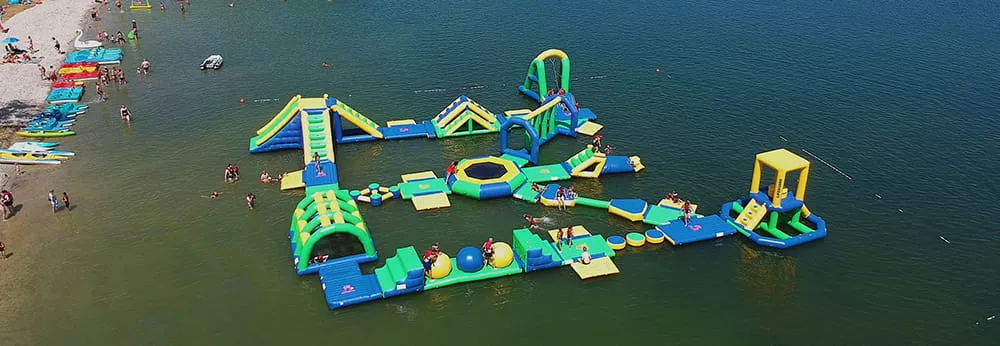
Inflatable water park before and after expansion from a smaller initial layout
An inflatable water park can start with a smaller layout and expand later

Begin With a Smaller Capacity and Modular Layout

Opening capacity should be based on realistic visitor demand, operating hours and supervision capacity. Instead of buying many disconnected low-cost units, begin with a balanced core course that provides a clear route, appropriate challenge levels and controlled entry and exit points.
A smaller park can reduce the first equipment order, the water area used and some operating requirements. However, it must still meet all anchoring, safety and installation needs for that opening layout.
Small modular inflatable water park layout designed to reduce the initial equipment investment
A smaller modular inflatable water park can reduce the initial equipment investment

Phase Optional Modules and Supporting Features

Additional high-thrill modules, extra capacity and nonessential supporting amenities can be scheduled for a later stage. These additions should follow demonstrated demand, visitor feedback and operating data.
What should not be postponed are the items required to operate the first phase correctly. Safety equipment, suitable access, secure anchoring, installation work and required compliance measures belong in the opening budget even when the park itself is small.

Protect Future Expansion From Day One

A low initial investment is only useful if the park can expand without expensive redesign. Reserve enough water area for the likely next phase, and plan entry points, exits, circulation routes and supervision positions before purchasing the first configuration. Future modules must also be compatible with the connection system and overall layout.
Expansion can change user capacity, anchoring loads and staffing requirements. These effects should be considered in the initial site plan. Operators with short or seasonal operating windows should also coordinate the first purchase and later phases with their commercial inflatable water park investment planning rather than copying another project’s configuration.

When a Low Budget Becomes Too Low

A budget is below the viable threshold when it can only work by omitting essential project scope. Warning signs include:
  • The budget covers the inflatable products but has no confirmed allowance for freight, local handling or installation.
  • There is no site assessment or anchoring allowance.
  • The planned visitor capacity is higher than the layout can support comfortably.
  • The quotation does not clearly state what equipment and services are excluded.
  • The project has no contingency reserve or working cash for the opening period.
  • The only way to proceed is to reduce safety, supervision or compliance preparation.
These gaps can create redesign costs, delayed opening, unplanned local purchases, downtime or early replacement. They can also increase safety and compliance risk. The cheapest quotation can therefore lead to a higher final investment if essential work has simply been left out.

How to Calculate Your Minimum Viable Project Budget

There is no single all-in minimum that applies to every site. Investors can, however, use the following formula to build a realistic starting figure:
Minimum viable budget = park system + site and anchoring + freight and installation + safety and compliance setup + pre-opening needs + contingency
Create a simple worksheet with one line for each category. Mark every figure as quoted, verified or unconfirmed. A supplier quotation is not a complete project budget while important categories remain unconfirmed.
Budget category
Amount
Status
Commercial park system
________
Quoted / Verified / Unconfirmed
Mandatory site and anchoring work
________
Quoted / Verified / Unconfirmed
Freight, local handling and installation
________
Quoted / Verified / Unconfirmed
Safety and compliance preparation
________
Quoted / Verified / Unconfirmed
Pre-opening operating needs
________
Quoted / Verified / Unconfirmed
Contingency reserve
________
Quoted / Verified / Unconfirmed
To complete the worksheet, the buyer should provide accurate site dimensions, water conditions, target capacity, project location and planned opening period. Without these inputs, the lowest number is only a preliminary product estimate, not a reliable minimum investment decision.

A Practical Go/No-Go Check Before You Buy

The project is ready to proceed only when the following statements are true:
  • The budget covers every non-negotiable category, not only the inflatables.
  • The opening layout fits the available water area and planned visitor capacity.
  • Site conditions and anchoring requirements have been reviewed.
  • The quotation’s inclusions and exclusions are clear in writing.
  • The operating and safety plan can support the first phase.
  • Future expansion remains possible without rebuilding the entire layout.
  • A reasonable reserve remains after the initial purchase and setup.
If one or more essential items cannot be funded, reduce the opening capacity or delay the project. Do not make the numbers work by removing site-critical or safety-critical scope.

Conclusion

The minimum investment to start a commercial inflatable water park is the lowest budget that can deliver a safe, launch-ready and commercially workable first phase. It is not the lowest equipment listing. Although a small commercial equipment package may begin at around US$14,000, the complete starting budget must be calculated around the actual site, capacity, installation, safety requirements and operating plan.
For investors with limited capital, the practical approach is to start with a smaller modular layout, protect all essential project costs and plan future expansion before the first purchase. To prepare a suitable starting configuration and project-scope quotation, share your site dimensions, water conditions, target capacity and planned opening period with Bouncia.

FAQs

Can I start a commercial inflatable water park with a small layout?

Yes. A modular layout can reduce the initial equipment order and operating scale, provided the layout still fits the site, planned user capacity, anchoring requirements and safety plan. Future expansion should be considered before the first layout is finalized.

What costs are commonly missing from an inflatable water park equipment quote?

Depending on the project, an equipment quote may not include freight, import charges, local handling, anchoring, installation, permits, insurance, safety equipment, staffing, storage or startup reserves. Buyers should confirm all inclusions and exclusions in writing.

How do I know whether my budget is too low?

The budget is too low if it only covers the inflatable equipment, requires cutting anchoring or safety scope, has no allowance for delivery and setup, or leaves no contingency and operating cash for launch. In this situation, reduce the opening scale or delay the project rather than removing essential requirements.
error: Content is protected !!