Welcome to Bouncia - Your Expert in Inflatable Water Parks and Diverse Sports Equipment

Bienvenue chez Bouncia - Votre expert en parcs aquatiques gonflables et en équipements sportifs divers.

Bienvenido a Bouncia - Tu Experto en Parques Acuáticos Hinchables y Equipamiento Deportivo Diverso

Hidden Advantages of Building a Floating Water Park in Artificial Lakes

When investors first explore a floating water park project, they often ask:
“If I don’t have a natural lake, can I still operate a water park?”
“Is an artificial lake really suitable?”
In reality, many successful operators choose to build artificial lakes for floating water parks instead of relying on natural lakes or bays. Examples can be found in Australia, including projects in Perth and cable parks in Melbourne.
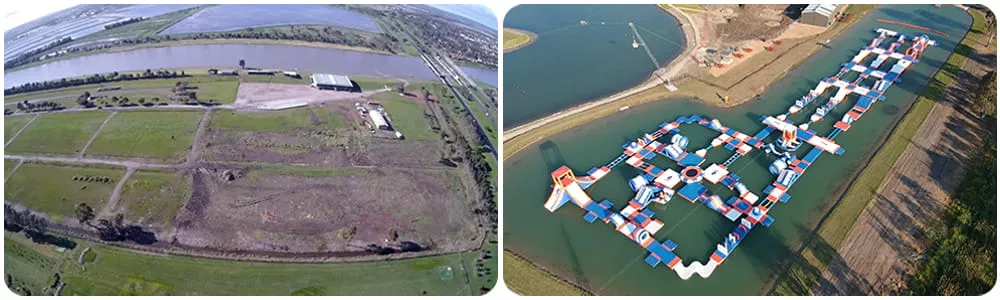
before-and-after-artificial-lake-floating-water-park-in-melbourne
Before-and-after view of a floating water park in an artificial lake
This article highlights the key advantages of artificial lakes—such as water stability, water quality control, permits, visual appeal, and safety—while comparing them with natural lakes and bays, helping investors evaluate a floating water park for sale with greater confidence.

1. Why Artificial Lakes Are an Underestimated Ideal Location

Compared with natural lakes and bays, the biggest advantage of artificial lakes is high controllability. In natural water bodies, factors such as water quality, wind speed, depth changes, tides, waves, and floating debris are often unpredictable and difficult to manage. In contrast, artificial lakes are planned, built, and maintained by humans, which means these key variables can be stabilized or controlled in advance.
For floating water park operators, a highly controllable water environment brings clear operational benefits:
  • More stable play experience, less affected by waves or water changes
  • More even load on equipment, reducing wear and tear
  • Easier risk control and more efficient safety patrols
  • Fewer shutdown days during peak season
  • More predictable returns and more stable operations
In short, artificial lakes significantly reduce uncertainty in daily operations, making the business more reliable and manageable.

2. Stable Water Flow: A Key Safety Advantage

Water flow is one of the most important factors for any floating water park.
Natural lakes may have hidden currents or seasonal flow changes. Bays are influenced by tides, with clear water level movement and wave action. In contrast, artificial lakes offer a stable and controlled water environment
  • Almost no hidden currents
  • Minimal water movement
  • No tidal influence
  • Easier installation and anchoring
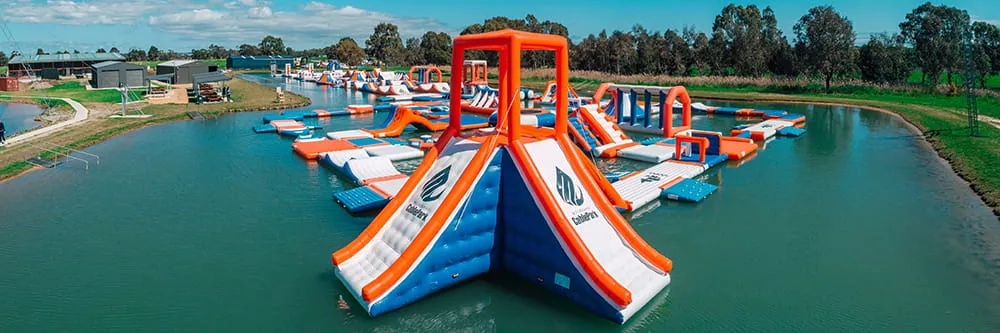
floating-water-park-on-calm-water-in-an-artificial-lake
A floating water park operating on calm and controlled artificial lake
For a Floating Water Park in Artificial Lakes, stable water flow directly improves safety, product lifespan, and user experience. In real operations, parks installed in artificial lakes often perform more smoothly and remain structurally stable over time.

3. Controllable Water Depth

For operating a floating water park, the ideal water depth is 2–4 meters. When building an artificial lake, this depth can be accurately planned in advance. In most areas, a depth of around 2.5 meters is sufficient for safe and efficient operation, while a deeper section of up to 4 meters can be designed in selected zones farther from the shore. This flexible depth design allows operators to arrange larger park elements when needed, something that is difficult to achieve in natural lakes or bays.

4. Easier Permit Process: Faster Opening, Faster Return

Permits are a major concern for floating water park investors. Because floating water parks are water-based attractions, approval procedures vary greatly depending on the water body type:
Water Type
Permit Complexity
Main Reasons
Bay
★★★★☆
Involves maritime authorities, coastal management, and environmental departments
Natural Lake
★★★☆☆
Involves water resource, environmental, and hydraulic authorities
Artificial Lake
★☆ or ★★☆☆☆
Often private land, resort-owned, or internally managed by local authorities
For a Floating Water Park in Artificial Lakes, this usually means:
  • Faster approval
  • Fewer departments involved
  • Clearer communication
  • Easier access to long-term operating permission
For investors, this leads to a quicker launch, faster market entry, and earlier returns—an important advantage when considering a floating water park for sale.

5. Better Water Quality Control: Improved Visual Impact and Safety

Water quality in natural lakes and bays changes with seasons and surroundings, and may suffer from:
  • Murky water
  • Eutrophication
  • Excessive aquatic plants
  • Algae growth
  • Strong corrosion in seawater
Artificial lakes, however, are usually managed by the owner or operator and can include:
  • Filtration systems
  • Regular water replacement
  • Disinfection and maintenance plans
  • Landscape and water circulation adjustments
This creates two major benefits:

(1) Better Visitor Experience

Clear water is naturally attractive. Visitors are more willing to enter the water and stay longer when the environment looks clean and inviting.
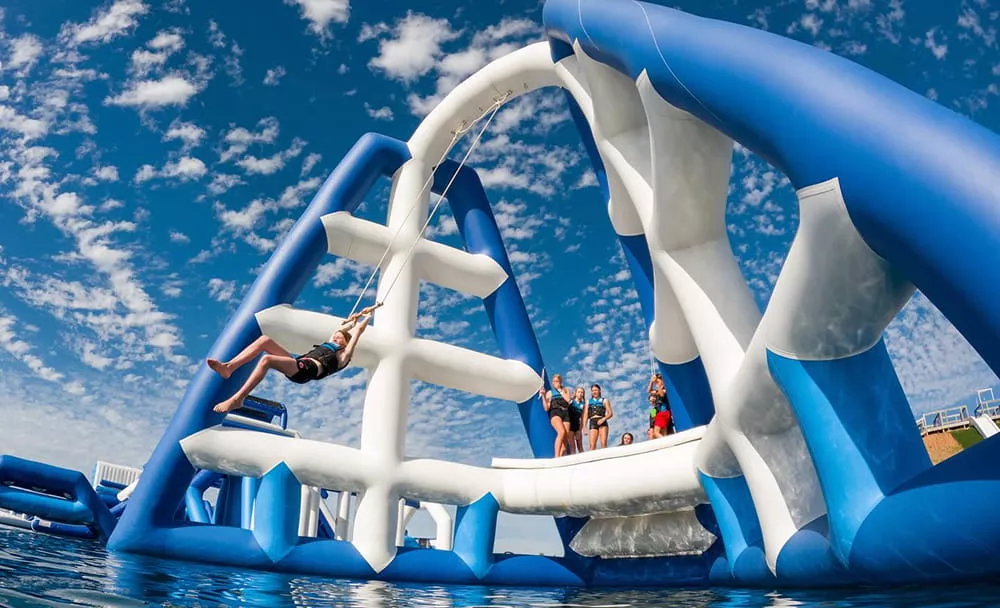
clear-water-floating-water-park-in-an-artificial-lake
Clear water in an artificial lake enhances visitor experience

(2) Longer Product Lifespan

Water in artificial lakes is generally less aggressive, reducing corrosion and dirt buildup on inflatables and accessories. This lowers maintenance costs and extends product life.

6. Higher Safety: Easier Monitoring and Rescue

Artificial lakes have clear boundaries and planned depths, without complex underwater structures. This makes safety management much simpler. Typical safety advantages include:
  • No underwater tree roots, rocks, or debris
clean-bottom-of-artificial-lake-floating-water-park
A clean bottom of artificial lake floating water park
  • Stable depth suitable for anchor layout
  • Easier placement of rescue and observation points
  • Clear separation of play zones
For any floating water park project, improved safety directly protects operational income and long-term investment value.

7. More Predictable Costs: Easier Installation and Maintenance

Because water flow and quality are more stable, operating costs in artificial lakes are generally lower:
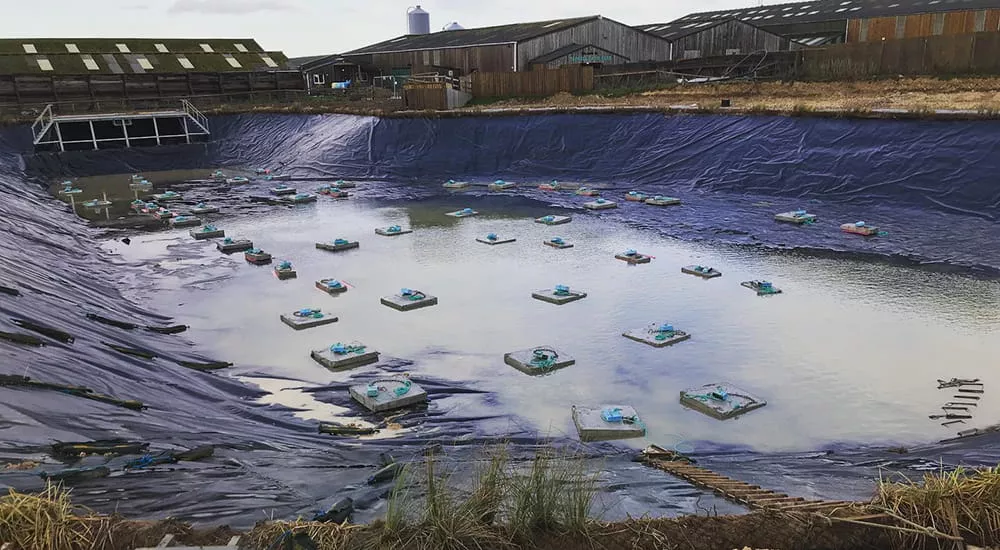
  • Easier anchoring; anchors or concrete blocks can be embedded during lake construction
anchors-and-concrete-blocks-installed-during-artificial-lake-construction
Anchors embedded during lake construction reduce future installation costs
  • Lower lifeguard staffing needs compared to natural lakes
  • Reduced equipment wear
  • More predictable artificial lake operations
Overall, artificial lakes help keep long-term operating costs under control.
For investors seeking a stable, efficient, and easy-to-manage location, artificial lakes are not just “possible”—they are often the better solution.
If you are evaluating a floating water park for sale, artificial lakes deserve serious consideration. Bouncia can also provide customized layout planning and professional support for your Floating Water Park in Artificial Lakes project, helping you move forward with confidence.

GET IN TOUCH WITH US

If you want to learn more about us or our products, welcome to leave a message below.