Welcome to Bouncia - Your Expert in Inflatable Water Parks and Diverse Sports Equipment

Bienvenue chez Bouncia - Votre expert en parcs aquatiques gonflables et en équipements sportifs divers.

Bienvenido a Bouncia - Tu Experto en Parques Acuáticos Hinchables y Equipamiento Deportivo Diverso

6 High-Risk Behaviors in Commercial Inflatable Water Parks and How to Prevent

In commercial inflatable water parks, the equipment itself is usually not the main safety issue. Most risks come from visitor rule violations and high-risk behaviors during play. Many real-world cases show that accidents are rarely caused by product quality, but by dangerous actions that were not identified or stopped in time—this is where commercial inflatable water park safety risks most often occur.
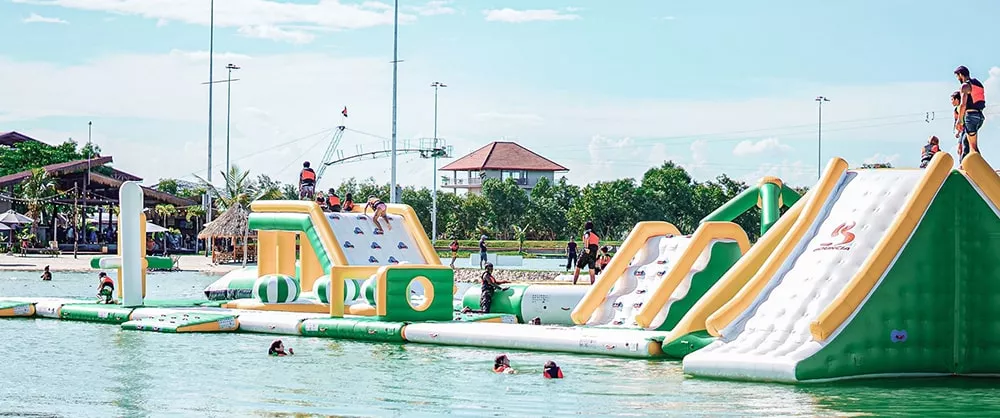
a-commercial-inflatable-water-park-on-operation
A commercial inflatable water park during daily operations
This article highlights 6 common but easily overlooked high-risk behaviors in daily operations and explains their causes, warning signs, correct intervention methods, and standard staff procedures, helping operators build a safer and more controllable management system.

1. Why “Safe Operation” Is More Important Than “Equipment Safety”

In real operations, there is a common rule in inflatable water parks: More than 80% of accidents happen when the equipment is normal, but visitor behavior is improper.
Common causes include:
  • Visitors are overexcited and ignore safety rules
  • Visitors try to show off or challenge limits
  • Crowded peak hours increase staff monitoring pressure
  • Visitors copy dangerous actions from others
  • Minors use attractions designed for adults
Equipment risks can be reduced by design and materials. However, visitor behavior cannot be controlled by design. It depends entirely on real-time staff management.
This is why a well-trained, fast-reacting, and standardized staff team directly determines the safety level and reputation of a commercial inflatable water park.

2. Typical Risk Sources in Commercial Inflatable Water Parks

During staff training, the first thing employees must understand is this: Risks follow patterns and can be predicted.

Most risks in a commercial inflatable water park come from:
  • Visitor behavior risks (jumping, pushing, chasing, climbing in the wrong direction)
  • Crowd density risks (crowded queues, overloaded platforms)
  • Product structure risks (high towers, jump platforms, narrow passages, slide entrances, areas where people can enter underneath)
  • Life jacket risks (not worn, worn incorrectly, loose straps)
  • Environmental factors (wind, waves, weather changes, low visibility)
Because of this, the core goal of safety training is not handling accidents afterward, but identifying high-risk behaviors early and stopping them in time
safety-rules-sign-at-a-commercial-inflatable-water-park
A safety rules sign in a commercial inflatable water park

3. Six Most Common High-Risk Behaviors (Key Training Points)

The following six behaviors appear in almost every commercial inflatable water park and are the main causes of accidents.

High-Risk Behavior 1: Jumping, Flying, or Backflipping from Non-Diving Attractions

no-jumping-from-non-diving-inflatable-water-park-illustration
A safety illustration warning against jumping from non-diving inflatables
(1)Why is it dangerous?
Products not designed for diving usually have no dedicated control. Jumping from these areas can land on people below or cause neck and lower back injuries due to incorrect water entry angles.
(2)How can staff identify it?
  • Visitors stay at the edge of high platforms
  • Repeated body swinging or testing jumps
  • Other visitors cheering or encouraging
(3)Correct way to stop it
  • Immediate verbal warning
  • Clearly direct the visitor to the correct slide or passage
  • Temporarily stop the visitor from playing if necessary
  • Diving is only allowed on designated diving platforms, one by one
(4)Standard handling process
Identify → Verbal stop → Explain rules → Record

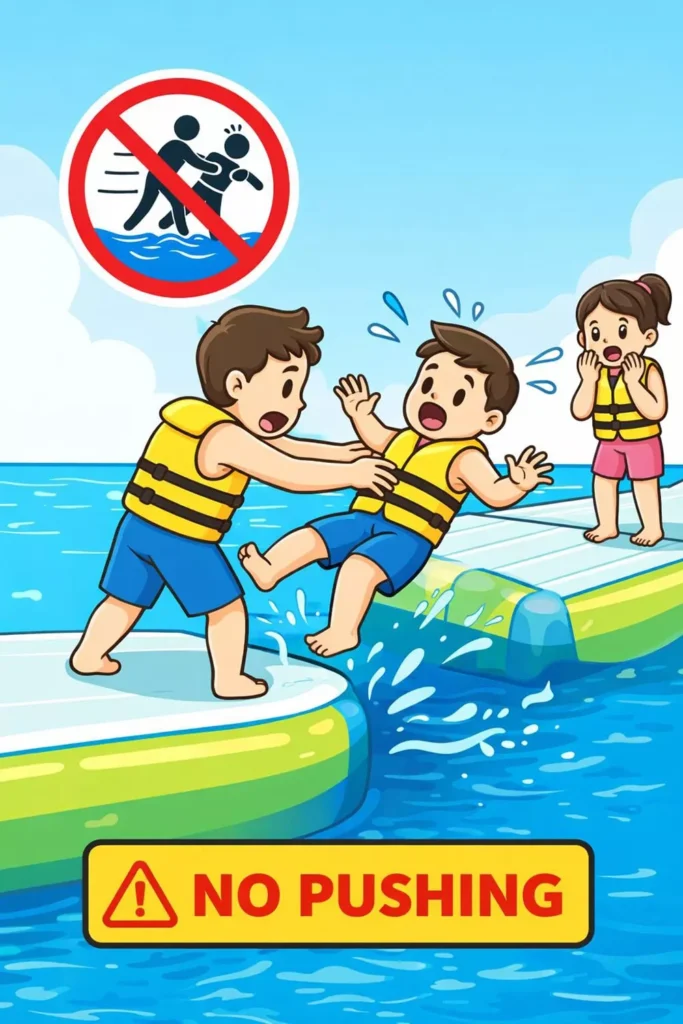
High-Risk Behavior 2: Pushing or Pranking Others at Edges

no-pushing-at-inflatable-water-park-platform-illustration
A safety illustration showing the danger of pushing others at edges
(1)Why is it dangerous?
Visitors who are pushed often fall into the water without preparation, leading to head-first entry or collisions with others.
(2)How can staff identify it?
  • Clear pushing movements
  • Playful but physical conflicts between visitors
  • Repeated “falling into water” incidents in the same area
(3)Correct way to stop it
  • Clearly warn: “No pushing”
  • Separate the involved visitors
  • Ask them to leave the area temporarily if needed

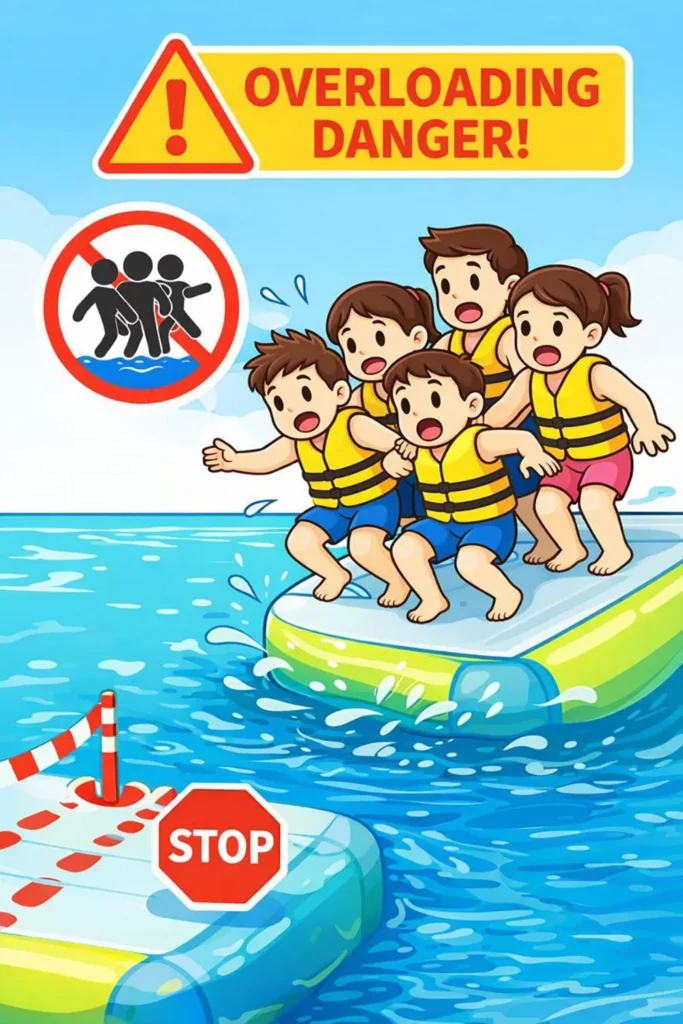
High-Risk Behavior 3: Too Many People on Narrow Platforms or Slide Entrances (Overloading)

overcrowded-inflatable-water-park-platform-safety-illustration
A safety illustration showing platform overloading in water parks
(1)Why is it dangerous?
Overloaded platforms lose balance easily, causing multiple people to fall into the water at the same time.
(2)How can staff identify it?
  • Queue lines are crossed
  • Multiple visitors waiting at the platform edge together
  • “Cutting in line” and crowding during peak hours
(3)Correct way to stop it
  • Control the number of people entering
  • Allow only one person per turn
  • Add more staff during busy periods

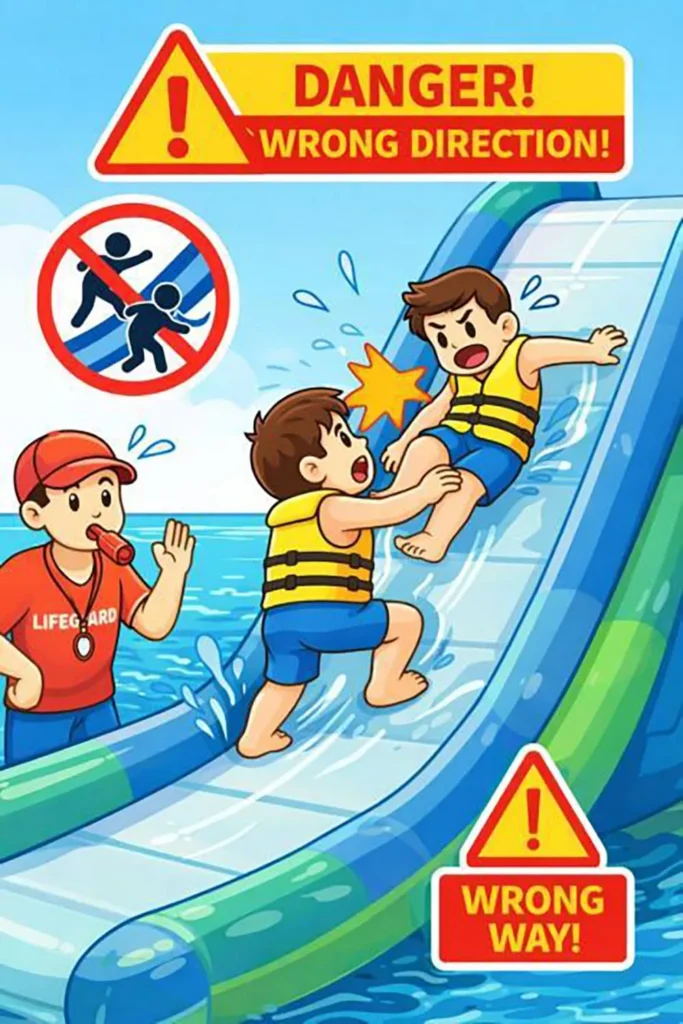
High-Risk Behavior 4: Climbing Slides or Running in the Opposite Direction

wrong-direction-climbing-on-inflatable-water-slide-illustration
A safety illustration showing dangerous opposite-direction movement
(1)Why is it dangerous?
Opposite-direction movement causes high-speed collisions with visitors coming from the correct direction.
(2)How can staff identify it?
  • Someone climbing up from the bottom of a slide
  • Visitors trying to “challenge” the difficulty
(3)Correct way to stop it
  • Stop immediately
  • Guide the visitor back to the starting point
  • Escalate action if the behavior repeats

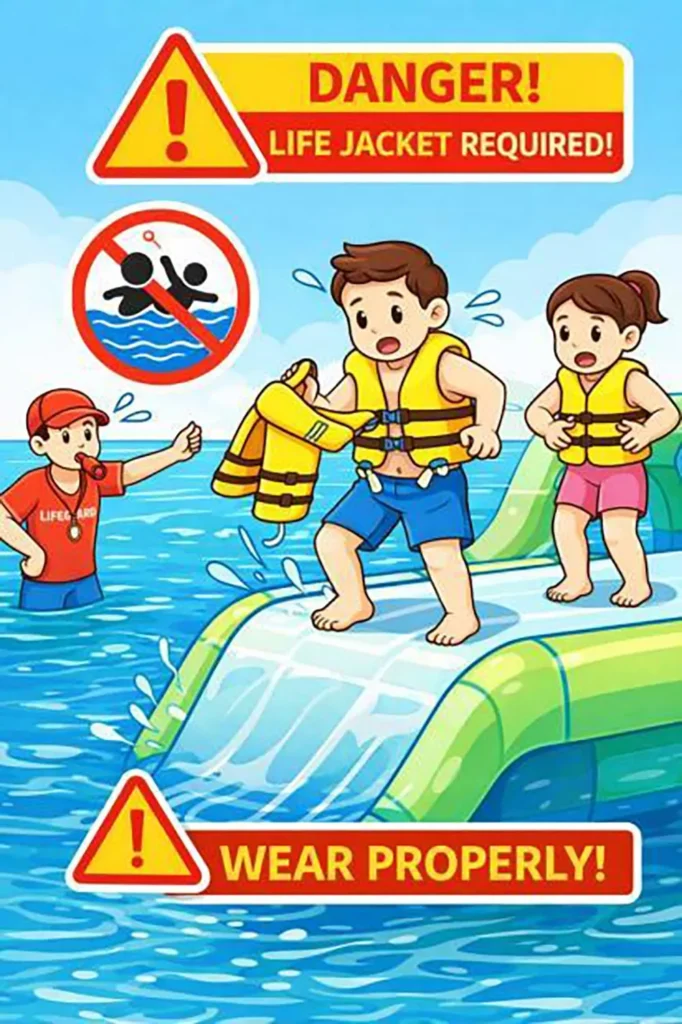
High-Risk Behavior 5: Removing or Incorrectly Wearing Life Jackets

incorrect-life-jacket-use-in-inflatable-water-park-illustration
A safety illustration showing improper life jacket use
(1)Why is it dangerous?
Life jackets are the last safety protection. Removing or wearing them incorrectly greatly increases drowning risk.
(2)How can staff identify it?
  • Buckles not fastened
  • Loose shoulder straps
  • Visitors removing jackets during play
(3)Correct way to stop it
  • Require immediate correction
  • Check size and fit
  • Do not allow play until properly worn

High-Risk Behavior 6: Bringing Hard Objects into Water Areas (Selfie sticks, cameras, glasses, etc.)

hard-objects-brought-into-inflatable-water-park-illustration
A safety illustration warning against hard objects in water areas
(1)Why is it dangerous?
Hard objects can fall or hit others, causing cuts or impact injuries.
(2)How can staff identify it?
  • Checks at queue entrances
  • Visitors holding items without storage
(3)Correct way to stop it
  • Entrance inspection
  • Guide visitors to storage areas
  • Clearly explain the rule

4. Standardized Safety Handling Procedures (SOP) for Staff

In commercial inflatable water park operations, inconsistent handling of the same violation causes two major problems:
  • Visitors feel confused or dissatisfied
  • Staff hesitate or overreact under pressure
Therefore, a key part of commercial inflatable water park safety training is ensuring that all frontline staff follow one unified process.
(1)Identify
Detect high-risk behaviors or warning signs early.
(2)Intervene
Stop immediately using clear and polite but firm instructions. Avoid vague reminders.
(3)Escalate
If visitors are emotional, repeat violations, or conflicts involve multiple people, inform supervisors or nearby staff.
(3)Document
Briefly record the violation type, time, and handling method for future analysis and training improvement.
Standardized procedures give staff confidence and significantly reduce conflicts with visitors.
Safety in inflatable water parks never depends on equipment alone.
Stable, safe, and sustainable operation comes from the combined system of equipment, rules, and staff training. If you are planning or operating a commercial inflatable water park and want to reduce risks while protecting visitor experience, systematic staff safety training is one of the most valuable investments.
If you would like to learn more about park layout planning, operational advice, or safety management experience, feel free to contact the Bouncia team. We are happy to share practical industry insights.

GET IN TOUCH WITH US

If you want to learn more about us or our products, welcome to leave a message below.